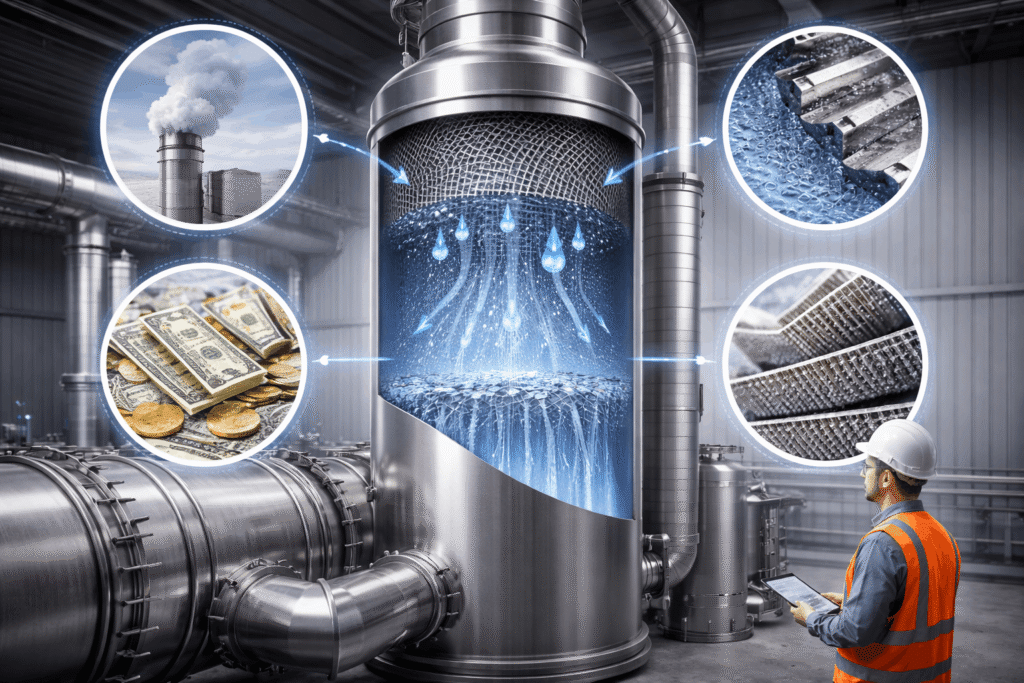

A mist eliminator is a fundamental component in engineered air pollution control systems where liquid aerosols, acid mists, and condensable vapors must be removed from process gas streams. Installed downstream of wet scrubbers, absorbers, quench towers, and condensers, the mist-eliminator filter performs final phase separation to ensure compliant discharge, protect downstream assets, and stabilize overall system performance.
Across chemical processing, refining, pharmaceuticals, metals, and power generation, industrial mist eliminators are not auxiliary devices; they are performance-critical separation systems. Proper selection, design, and integration—often in collaboration with experienced mist eliminator suppliers and manufacturers—directly influence emissions compliance, energy consumption, maintenance exposure, and lifecycle cost.
1. High-Efficiency Removal of Liquid Aerosols
A properly engineered mist eliminator captures entrained droplets across a broad particle-size distribution, including submicron aerosols that evade conventional gravity settlers or low-efficiency mesh pads. Through inertial impaction, interception, and coalescence, industrial mist eliminators achieve high removal efficiency under corrosive, high-moisture, and variable-load conditions.
This capability is essential in controlling sulfuric acid mist, hydrochloric acid aerosols, solvent vapors, and condensable hydrocarbons.
2. Improved Environmental Compliance
Industrial air permits governing hazardous air pollutants, and visible emissions require predictable mist control. A high-performance mist-eliminator filter reduces stack opacity and liquid carryover, supporting consistent compliance during stack testing and regulatory audits.
Stable droplet removal minimizes emissions variability and reduces compliance risk under fluctuating process conditions.
3. Protection of Downstream Equipment
Liquid carryover accelerates corrosion, erosion, and fouling in ductwork, induced-draft fans, heat exchangers, and stacks. By removing entrained droplets prior to discharge, a mist eliminator preserves mechanical integrity and extends service intervals.
The reduction in corrosion-related failures lowers capital replacement frequency and mitigates unplanned downtime.
4. Stabilized Wet Scrubber and Absorber Performance
Wet scrubbers and absorbers depend on effective mist separation following gas–liquid contact. Without adequate droplet removal, solvent losses increase and mass-transfer efficiency declines.
Industrial mist eliminators prevent liquid re-entrainment, maintain absorber chemistry, and support consistent removal efficiency of acid gases and other contaminants.
5. Reduced Product and Reagent Loss
In many operations, the captured liquid phase contains valuable product, catalyst, or reagent. A properly designed mist-eliminator filter enables recovery and return to the process rather than discharge to the atmosphere.
Improved material recovery enhances overall process economics and supports sustainability objectives.
6. Lower Maintenance and Downtime Exposure
Entrained liquid deposition contributes to solids buildup, scaling, and corrosion in downstream systems. Effective mist elimination reduces fouling frequency and maintenance interventions.
Predictable pressure drop behavior further supports condition-based monitoring and proactive service scheduling.
7. Enhanced Workplace and Environmental Conditions
Uncontrolled mist emissions create slip hazards, reduced visibility, and inhalation risks within operating areas. Industrial mist eliminators reduce fugitive liquid carryover, contributing to improved housekeeping standards and safer operating environments.
8. Controlled Pressure Drop and Energy Efficiency
A mist eliminator must balance capture efficiency with acceptable pressure drop. Excessive resistance increases fan horsepower demand and operating cost; insufficient resistance compromises droplet removal.
Engineered designs from qualified mist eliminator suppliers maintain this balance, minimizing total system energy consumption while preserving high-efficiency separation.
9. Versatility Across Industrial Applications
Industrial mist eliminators operate in corrosive environments, elevated temperatures, and high liquid loading services. Proper material selection—whether metallic, polymeric, or composite—ensures chemical compatibility and structural integrity.
Engagement with experienced mist eliminator suppliers and manufacturers ensures alignment between droplet size distribution, gas velocity, liquid properties, and separator configuration.
10. Long-Term Reliability with Engineered Design
Long-term performance depends on:
- Uniform gas distribution
- Adequate drainage design
- Chemical compatibility
- Conservative velocity selection
A properly engineered mist-eliminator filter maintains stable differential pressure and consistent droplet capture over extended operating cycles.
Integration Within Industrial Air Pollution Control Systems
Within a complete air pollution control train, the mist eliminator performs final-phase polishing of the exhaust stream. Its performance directly affects:
- Emissions compliance margins
- Fan energy consumption
- Downstream corrosion rates
- Maintenance frequency
Improper mist control compromises the entire system, regardless of upstream scrubber efficiency.
Key Selection Considerations
When specifying industrial mist eliminators, engineering evaluation should include:
- Droplet size distribution and liquid loading rate
- Superficial gas velocity
- Gas temperature and chemical composition
- Liquid density, viscosity, and surface tension
- Materials of construction and corrosion allowance
Qualified mist eliminator suppliers assess these parameters to define the appropriate geometry, media configuration, and allowable operating window.
A Critical Investment in Industrial Emissions Control
Effective aerosol removal is central to regulatory compliance, equipment protection, and operating stability. A mist eliminator is not a commodity component; it is a process-critical separation device requiring disciplined engineering.
Kimre™ Clean Air Technology applies a data-driven methodology to mist elimination design, integrating fluid dynamics, mass transfer principles, and field operating experience to deliver reliable performance under demanding industrial conditions.
Facilities evaluating upgrades or new installations should align mist control strategy with defined process objectives, compliance requirements, and long-term operating economics.