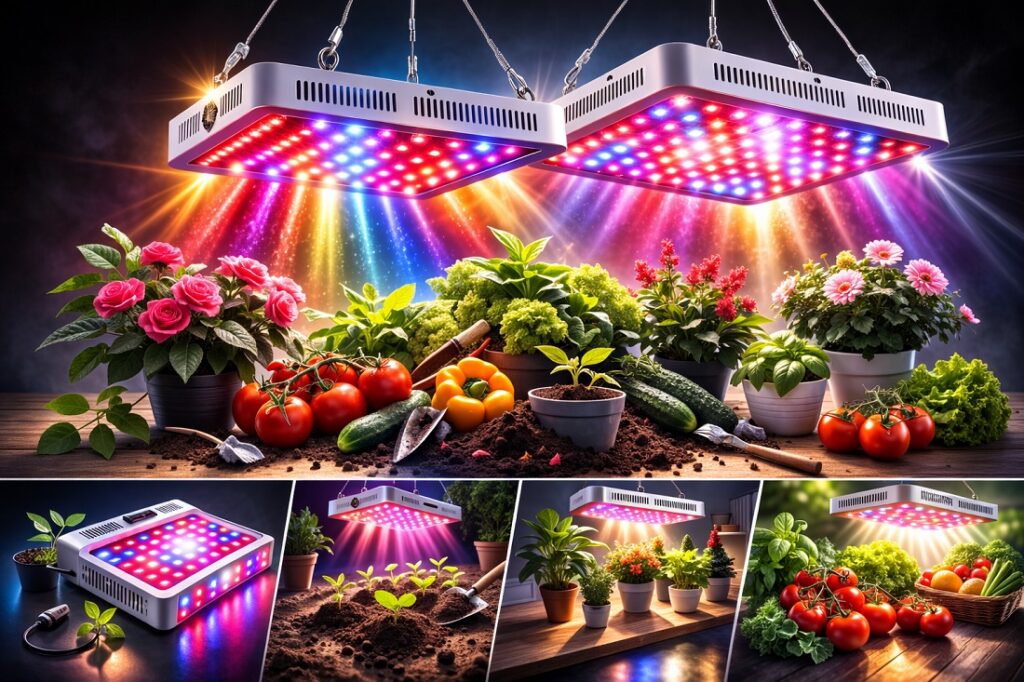

Healthy foliage and strong stem structure are foundational to crop performance, yield consistency, and harvest quality in commercial greenhouse and controlled environment agriculture (CEA) operations. Modern LED grow lighting allows growers to actively manage plant morphology rather than react to deficiencies after they occur.
This article outlines seven scientifically grounded ways that properly designed grow lighting systems support healthier leaves and stronger stems, with emphasis on commercial production environments.
1. Increased Photosynthetic Efficiency
Photosynthesis is the primary driver of plant growth. Adequate light intensity and appropriate full spectrum LED lights directly determine how efficiently leaves convert light energy into carbohydrates.
High-quality LED grow lights deliver usable photons efficiently, supporting:
• Higher chlorophyll production
• Increased photosynthetic rates
• Thicker, darker green leaves
• Improved leaf structural integrity
Stable photon output over time ensures consistent photosynthesis across the crop cycle, resulting in uniform canopy development and predictable growth outcomes.
2. Spectrum-Guided Stem Morphology
Light spectrum influences how plants allocate growth between leaves, stems, and internodes. While total photon delivery determines growth rate, spectral balance shapes plant architecture.
Key spectrum effects include:
• Blue wavelengths promoting compact growth, thicker stems, and reduced internode length
• Red wavelengths supporting photosynthesis and biomass accumulation
• Balanced white light (including green wavelengths) improving canopy penetration and morphology
Advanced LED lights for plants coordinate spectrum and intensity together, enabling growers to guide stem strength and plant structure without sacrificing overall growth performance.
3. Reduced Radiant Heat at the Canopy
Legacy lighting technologies such as HPS emit significant radiant heat toward plant tissue. Excess canopy heat can:
• Damage leaf tissue
• Increase transpiration stress
• Disrupt metabolic processes
LED grow lights significantly reduce radiant heat at the canopy level, allowing:
• Closer fixture mounting
• Improved vertical density
• Reduced risk of leaf burn
• More stable plant temperatures
It is important to note that LEDs improve thermal uniformity but do not replace greenhouse space heating requirements.
4. Uniform Light Distribution Across the Canopy
Even light distribution is essential for consistent leaf and stem development. Uneven illumination causes plants to stretch toward light sources, resulting in weak stems and inconsistent growth.
Fixed-installation LED systems provide:
• Uniform PPFD across the growing area
• Consistent morphology from edge to center
• Reduced plant-to-plant variability
• Predictable harvest timing
Uniform lighting ensures that all plants develop comparable stem thickness and leaf density.
5. Photoperiod Control and Growth Regulation
Photoperiod directly affects plant hormonal signaling that governs vegetative growth, stem elongation, and flowering initiation.
Programmable lighting systems enable:
• Extended vegetative growth periods for stronger stems
• Controlled transitions between growth stages
• Regulation of internode elongation through day-length management
• Repeatable production scheduling year-round
Matching photoperiod to crop growth stage supports balanced structural development.
6. Improved Nutrient Utilization Efficiency
Light energy drives nutrient uptake and assimilation. When PPFD and DLI targets are met, plants more efficiently convert available nutrients into structural tissue.
Benefits of adequate lighting include:
• Improved nitrogen utilization for chlorophyll and protein synthesis
• Enhanced phosphorus and potassium assimilation
• Stronger vascular development in stems
• Improved root-to-shoot nutrient transport
Better nutrient efficiency reduces the need for excess fertilization while improving overall plant strength.
7. Environmental Stability and Reduced Stress
Lighting interacts directly with temperature, humidity, and airflow management. Predictable, low-radiant-heat LED systems improve environmental stability by:
• Reducing temperature fluctuations
• Supporting consistent vapor pressure deficit (VPD)
• Lowering stress-induced growth interruptions
• Improving disease management conditions
Stable environments allow plants to allocate energy toward growth rather than stress responses, resulting in thicker leaves, stronger stems, and improved crop quality.
Lighting as Structural Infrastructure
Grow lighting should be treated as core infrastructure in commercial greenhouse and vertical farming operations. Properly designed LED systems provide repeatable control over light intensity, spectrum, and photoperiod—key drivers of plant structure and health.
GROW3, a division of LED Smart Inc., designs spectrum-tunable LED grow lighting systems for professional greenhouse and vertical farming environments. GROW3 fixtures deliver stable PPFD, balanced full-spectrum output, and fixed-installation uniformity to support consistent leaf development and stem strength across crop cycles.