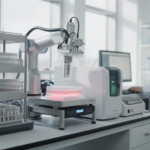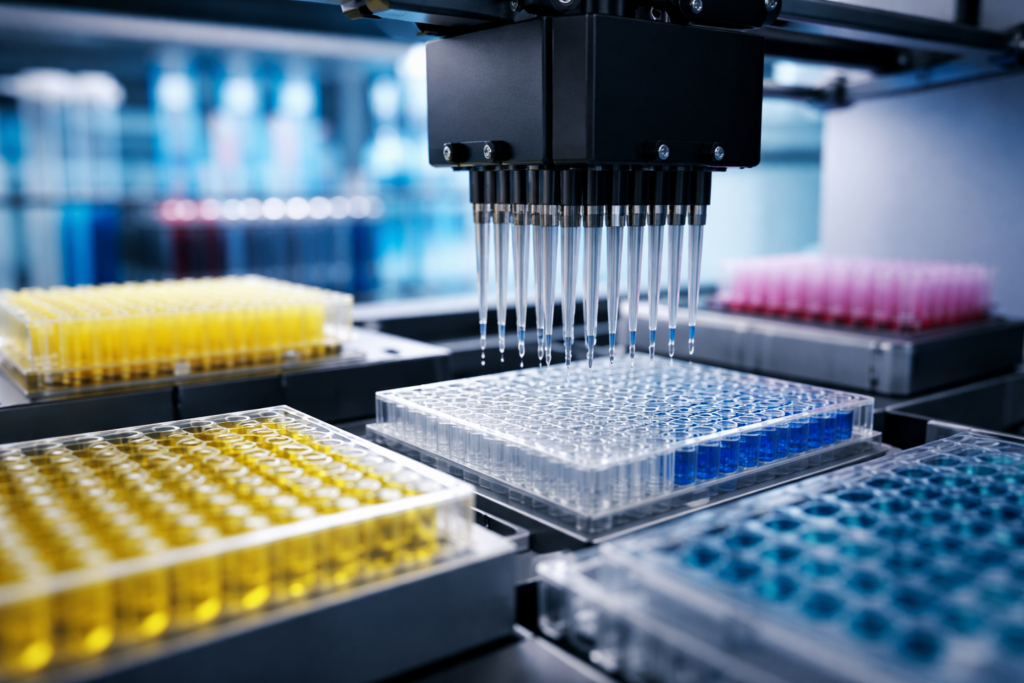

Handling hundreds or even thousands of samples daily requires more than skilled technicians; it demands consistency at a level that manual processes cannot sustain. Variations in pipetting, timing, and technique can quickly impact experimental outcomes, especially in data-sensitive fields like genomics and diagnostics. Automated liquid handling addresses these challenges by bringing precision and repeatability into every step of the workflow.
As laboratory demands continue to grow, automation is no longer a convenience but a necessity. By integrating advanced liquid handler equipment, labs can streamline complex protocols, reduce variability, and maintain consistent performance across high-throughput applications.
1. DNA and RNA Sample Preparation in Genomics
Automated liquid handling simplifies nucleic acid extraction and preparation by ensuring consistent sample processing. It reduces variability and supports high-throughput genomic workflows, improving data reliability.
2. PCR and qPCR Setup
Preparing PCR and qPCR reactions requires precise reagent dispensing. Automation ensures accurate volume distribution across wells, minimizing errors and improving amplification consistency.
3. Next-Generation Sequencing (NGS) Library Preparation
NGS workflows involve complex multi-step protocols. Automated systems streamline library preparation by handling repetitive pipetting steps with precision, reducing turnaround time and variability.
4. ELISA and Immunoassay Workflows
ELISA assays rely on consistent reagent addition and washing steps. Automated liquid handling improves reproducibility by standardizing liquid transfer across plates, ensuring reliable assay performance.
5. High-Throughput Drug Screening
Drug discovery depends on efficiently processing large compound libraries. Automation enables rapid and accurate dispensing of compounds, supporting large-scale screening with minimal manual intervention.
6. Cell-Based Assay Preparation
Cell-based assays require careful handling to maintain viability. Automated systems provide controlled dispensing of media and reagents, ensuring uniform conditions across experiments.
7. Clinical Diagnostic Testing
Clinical laboratories rely on accuracy and repeatability. Automated liquid handling supports diagnostic workflows by reducing human error and ensuring consistent sample preparation, both of which are critical for reliable test results.
8. Reagent Optimization and Assay Development
During assay development, multiple conditions must be tested. Automation allows precise variation of reagent volumes, enabling efficient optimization and faster development cycles.
9. Microplate Replication and Sample Distribution
Replicating samples across microplates is essential for comparative studies. Automated systems ensure uniform distribution, reducing variability and improving experimental consistency.
10. Integration with Fully Automated Lab Workflows
Modern laboratories operate through interconnected systems. Automated liquid handling integrates seamlessly with robotic platforms, plate readers, and data systems, enabling continuous, end-to-end workflow automation.
Driving Efficiency and Accuracy Across Modern Laboratories
Automated liquid handling has become a foundational component of high-performance laboratories. From genomics to diagnostics and drug discovery, it ensures precision, scalability, and consistency across complex workflows.
Copia Scientific delivers certified pre-owned automation solutions through its Copia 360 System, offering validated performance, documentation, and warranty-backed reliability. Integrating advanced liquid handling instruments into laboratory workflows improves reproducibility and operational efficiency. Connect with Copia Scientific today to strengthen lab performance with trusted automation solutions.