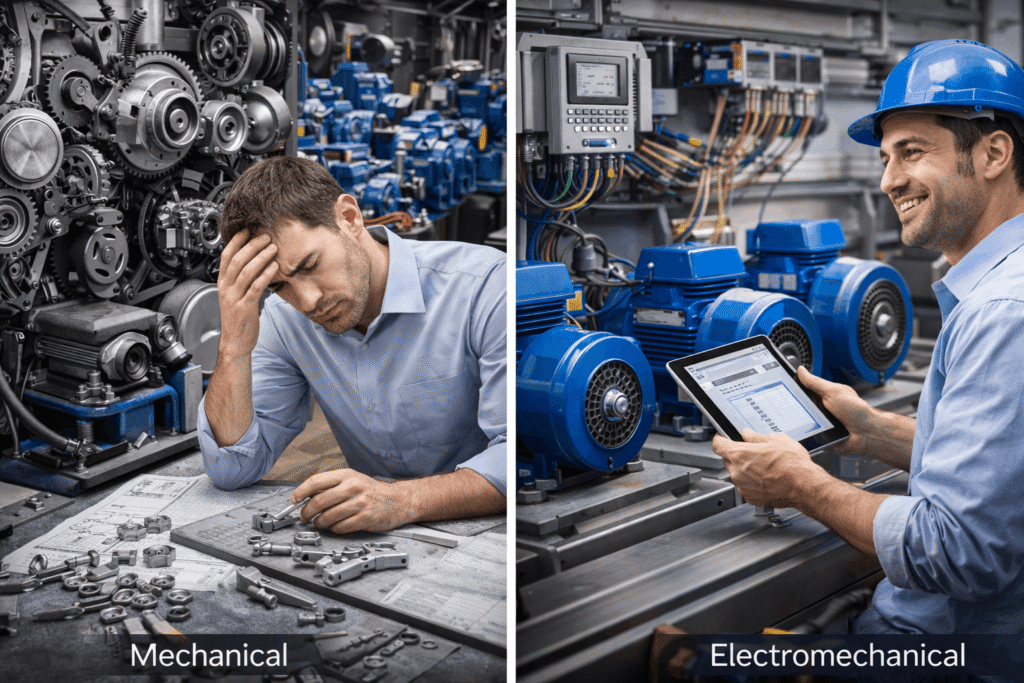

OEMs across Canada continue to evaluate how components move from fabrication into final integration. As supply chains tighten and production timelines shorten, consistency and repeatability now matter more than variety or complexity. This shift has led many OEMs to reassess how mechanical assemblies compare with more structured, electromechanical approaches.
Rather than relying on loosely coordinated parts or broad assembly services, OEMs increasingly favour better assembly models. These means models that reduce handling, limit variability, and integrate cleanly into established manufacturing workflows.
Mechanical Assemblies vs. Electromechanical Assemblies: A Practical Comparison
In many OEM environments, traditional mechanical assemblies refer to groupings of fabricated or machined metal components assembled to meet a functional requirement. These assemblies often prioritize fit and form but may require additional internal coordination before they are production-ready.
By comparison, electromechanical assemblies combine simple mechanical components with basic electrical or fastening elements in a controlled, repeatable manner. The emphasis is not on complexity, but on consistency and ease of replication.
From an OEM perspective, the difference lies in how predictable the outcome is once the assembly reaches the production floor.
How OEMs Define Customization in Assembly Work
For OEMs, customization does not imply intricate systems or fully integrated products. Instead, it reflects assemblies designed for specific production needs while remaining straightforward to manufacture and inspect.
In a comparative context, mechanical assemblies may vary more between production runs due to manual coordination or multiple sourcing points. In contrast, electromechanical assembly work is typically structured around repeatable processes, standardized fasteners, and machining constraints that match real-world capabilities.
This distinction helps OEMs maintain control without introducing unnecessary variation.
Repeatability and Risk: Where the Difference Becomes Clear
When OEMs compare traditional mechanical assembly approaches with electromechanical assembly solutions, repeatability often becomes the deciding factor.
Electromechanical approaches support:
- Reduced handling between fabrication and integration
- Fewer alignment issues during installation
- More predictable inspection and quality checks
- Easier reuse across multiple product lines
While mechanical assemblies still play a role in many applications, OEMs often find that simpler electromechanical configurations reduce downstream risk and internal rework.
Manufacturing Constraints and Design Considerations
Another key comparison point lies in how well assemblies align with manufacturing realities. Assemblies designed without regard for machining limits or inspection requirements can slow production.
Effective electromechanical assembly work is guided by design choices that support:
- Straightforward geometries
- Standardized fasteners and fittings
- Tolerances compatible with 3-axis CNC machining
- Materials suited for forming and machining processes
By contrast, mechanical assemblies that push beyond these constraints may require additional adjustments before they can be scaled reliably.
Where OEM Demand Is Shifting
OEM demand continues to grow in sectors that rely on precision components rather than finished products. In these environments, assemblies support larger systems without becoming products themselves.
Common examples include:
- Industrial equipment components
- Electronics enclosures and housings
- Medical device component supply chains
In medical applications, this distinction is especially important. Assemblies support devices but are not devices themselves, requiring a clear focus on component-level manufacturing rather than end-product development.
Evaluating Assembly Partners: A Comparative Lens
When OEMs assess mechanical assembly companies, their evaluations increasingly focus on consistency rather than breadth of services. Broad capabilities can introduce variability, while focused assembly work supports predictable outcomes.
OEMs typically look for partners that demonstrate:
- Experience with machined and formed metal components
- The ability to deliver simple, repeatable assemblies
- Quality systems that support inspection and documentation
- A clear understanding of production constraints
In many cases, OEMs find that partners specializing in electromechanical assembly solutions better align with their long-term production goals.
A Measured Approach to Assembly Strategy
Compared with other components, mechanical assemblies remain part of many OEM supply chains. However, as production pressures increase, OEMs are increasingly favouring assembly models that prioritize simplicity, repeatability, and manufacturing discipline.
Electromechanical approaches help reduce friction between fabrication and integration without introducing unnecessary complexity. For OEMs seeking dependable support, the focus continues to shift toward reliable mechanical assembly companies. This means partners that deliver controlled, repeatable assembly outcomes rather than expansive or highly complex solutions.