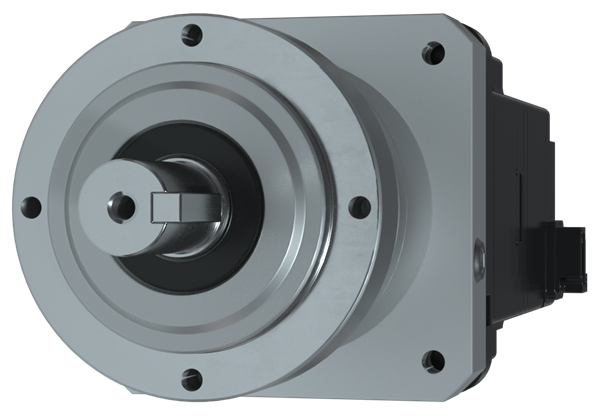

Modern facilities still rely heavily on the induction motor for pumps, fans, compressors, conveyors, and process equipment. Recognizing their reliability helps facilities feel secure while understanding the potential for improved control and efficiency.
That’s where the combination of an induction motor and a Variable Frequency Drive (VFD) comes in. Instead of operating at a fixed speed, the motor can respond to load changes dynamically—without mechanical throttling or constant start/stop cycling. If you’re selecting a new motor for industrial use, our range of induction motor options is a strong starting point for both direct-on-line (DOL) and VFD-driven applications.
How Induction Motors Operate Without VFDs
A standard induction motor running without a VFD typically operates in a straightforward way:
- The motor receives fixed-frequency power (usually 60 Hz in Canada)
- Speed stays close to the motor’s synchronous speed (minus slip)
- Control is typically limited to:
- ON/OFF switching
- mechanical dampers (fans)
- valves/throttling (pumps)
This works well for “always-on” loads, but it introduces inefficiencies when load demand fluctuates. In many cases, the motor continues running at full speed even when the process needs less output—creating wasted energy and unnecessary wear.
Performance Improvements Using Induction Motor VFDs
Adding an induction motor VFD changes the entire capability of the motor system. A VFD controls motor speed by adjusting frequency and voltage, providing variable-speed control rather than fixed-speed operation.
Key advantages include:
- Accurate speed control
- Match motor output to real-time process demand
- Improve consistency for production lines and material handling
- Soft start / soft stop
- Reduce mechanical shock on couplings, belts, and gearboxes
- Lower electrical inrush current during startup
- Better torque handling at different speeds
- With the proper drive configuration, induction motors can deliver strong torque performance across speed ranges
- Improved automation integration
- VFDs often support Modbus, BACnet, or other industrial protocols for facility automation control
This is why induction motor drives are now common in HVAC systems, water plants, manufacturing, food processing, and logistics facilities.
Energy And Maintenance Comparisons
This is where the difference becomes measurable.
Energy use: fixed speed vs variable speed
Without a VFD, operators often control output mechanically:
- pump flow controlled with valves
- fan airflow controlled using dampers
That means the motor still consumes high energy even when the output demand is lower.
With a VFD:
- The motor speed is reduced instead
- Energy draw drops significantly for variable torque loads like pumps and fans
In real-world facility operations, this can translate into meaningful cost savings—especially in systems that run many hours per day.
Maintenance impact
A VFD-driven induction motor system can lower maintenance by reducing:
- startup stress (less impact and vibration)
- shock loading on mechanical components
- overheating caused by excessive cycling
However, VFD integration can introduce new considerations:
- motor insulation must be suitable for inverter duty (especially in older motors)
- facilities may need to consider harmonics and cable length best practices
- cooling may be required at very low speeds in continuous-duty applications
So while VFD systems can reduce mechanical wear, they require proper specification to avoid electrical stress.
Conclusion – When VFD Integration Makes Sense
A traditional induction motor running direct-on-line still makes sense when:
- speed never needs to change
- load demand is stable
- simplicity is the top priority
But in modern facilities where efficiency and control matter, pairing an induction motor with a VFD often delivers better long-term value. If your process includes fluctuating demand, extended operating hours, or equipment that benefits from controlled acceleration, an induction motor drive setup is typically the smarter choice. Contact us today for more information.