
Biotech labs are scaling faster than ever—adding instruments, increasing throughput, and running more parallel workflows across shared spaces. In this environment, automation must do more than execute tasks; it must coordinate people, robots, and instruments as a single system. That’s why scalable lab automation services have become critical to modern R&D operations.
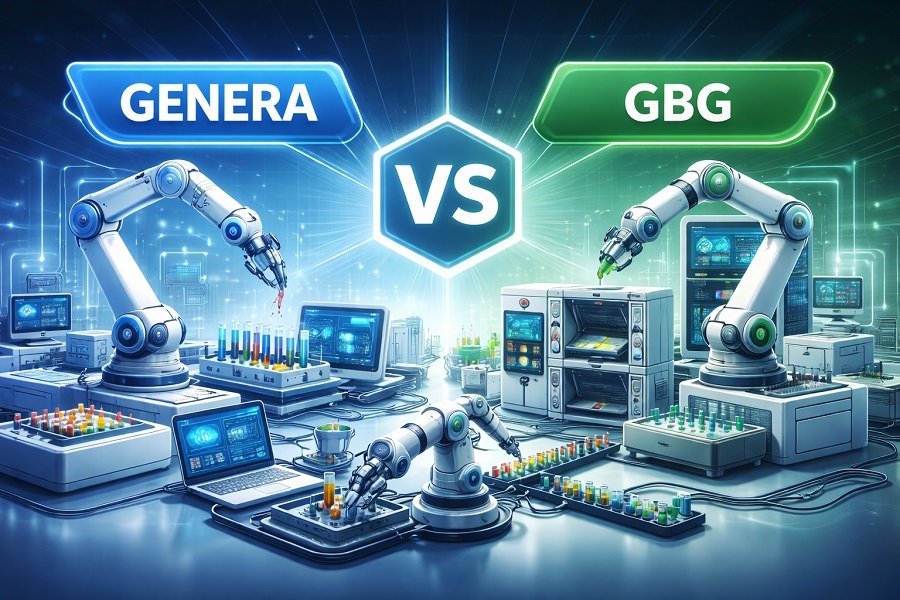
Companies work closely with biotech teams re-evaluating their automation stacks as robotics adoption increases. One of the most common comparisons we see is between GENERA and Green Button Go (GBG). Both platforms support automation, but their approaches to robotics integration and long-term scalability differ in important ways.
What GENERA and GBG Offer for Laboratory Automation Solutions
Both GENERA and GBG are used to manage automated workflows, yet they prioritize different goals.
GENERA is built as an orchestration-first platform. As part of our laboratory automation solutions, GENERA acts as a central control layer that coordinates instruments, robotic devices, and timing across workflows. Instead of managing devices independently, it treats automation as a connected ecosystem that can evolve as labs grow.
GBG is commonly used as a scheduling and execution layer within specific automation setups. It is often paired with robotic systems in well-defined configurations, helping labs queue tasks and execute runs with minimal manual intervention. For labs with relatively fixed automation layouts, GBG can provide reliable execution.
The key distinction lies in how each platform handles change, expansion, and multi-robot environments.
Robotics Integration – Comparing Support for Laboratory Robotics and Automation
Robotics integration is where differences between the two platforms become most apparent.
GENERA is designed to support diverse laboratory robotics and automation environments. It integrates directly with robotic arms, liquid handlers, incubators, readers, and storage systems through APIs and device drivers. This allows robots to operate within a coordinated workflow rather than as isolated units. When one step completes early or a device becomes available, GENERA dynamically adjusts schedules to keep robots and instruments productive.
GBG supports robotics integration primarily within predefined automation cells. It works well when robotic workflows are stable and predictable, but it can be less adaptable when labs introduce new robots, reconfigure layouts, or shift project priorities. Changes may require additional setup or workflow restructuring.
Biotech labs increasingly value orchestration over static execution. As robotics footprints grow, the ability to coordinate multiple robots across shared resources becomes more important than optimizing a single fixed workflow.
Lab Use Case Fit – Which Platform Better Supports a Robotics and Automation Laboratory
The best platform choice depends on how a lab operates today—and how it plans to operate tomorrow.
GENERA is typically the better fit for:
- Labs with mixed-vendor robotics and instruments
- Facilities operating shared robotic resources across teams
- Environments where workflows change frequently
- Organizations scaling automation incrementally
Because GENERA functions as orchestration-centric automation software, it supports phased growth. Labs can start with one robot or workflow and expand without rearchitecting their entire system.
GBG may be a good fit for:
- Labs with fixed automation cells
- Highly standardized workflows that rarely change
- Environments where robotics are tightly coupled to a specific setup
However, as labs evolve into more complex laboratory robotics and automation environments, limitations in flexibility can become more apparent. Robotics integration is no longer just about running a robot—it’s about coordinating many automated assets efficiently.
Final Verdict on Platform Flexibility and Scalability for Biotech Workflows
Both GENERA and GBG play roles in lab automation, but they are built for different stages of maturity. GBG can be effective in stable, well-defined automation environments. GENERA, however, is designed for biotech labs that expect growth, change, and increasing robotics complexity.
The company built GENERA to support long-term scalability. Our focus is on helping labs integrate robotics into a connected automation strategy—one that adapts as workflows, instruments, and teams evolve. By prioritizing orchestration, integration, and flexibility, we enable biotech facilities to future-proof their automation investments.
For labs building or expanding a robotics and automation laboratory, the decision comes down to whether your automation platform can grow with you. In environments where robotics integration is expected to expand and diversify, flexibility and depth of orchestration often make the difference.